Wednesday, November 24, 2010

Revisiting The Myth of Yams and Pumpkin Pie

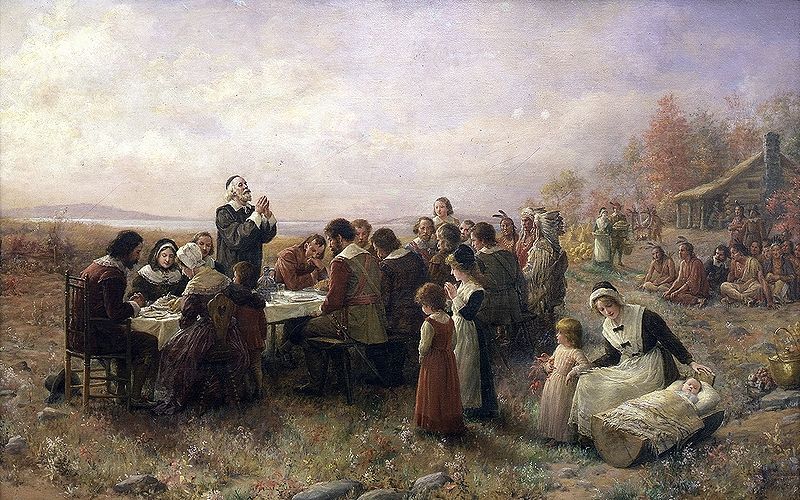
"The First Thanksgiving at Plymouth" (1914)
By Jennie A. Brownscombe

With the approach of Thanksgiving, elementary school aged children in the United States prepare to play yams in school plays, and sing songs about pumpkin pie and cranberries. They may dress up as Pilgrims in costumes with black hats and large, shiny buckles. And they often mime a feast with Native Americans signifying the beginning of a tradition of giving thanks in November. Their parents are undoubtedly delighted—as they should be: every child needs a picture dressed as a yam. 

These elements of Thanksgiving are the same half-truths that I was taught as a child. I say half-truths because Thanksgiving is a constructed holiday—over the years we have pieced together history and popular customs to create this national festival. It's based on a feast of thanksgiving, a religious event where the celebrants gave thanks to their god(s).

Wednesday, November 17, 2010

Monday, November 15, 2010

Evolving Together: Human Interference Not ALL Bad


There is no denying that humans have had a lasting impact on the environment, however biologist Jacques Blondel (2006) suggests that these ideas overlook the ways human activity has actually contributed to the maintenance, diversity, and embellishment of landscapes (714). Blondel acknowledges that there is a middle ground between these ideas when it comes to the relationship we have with our landscapes—a balance must exist between resistance and resilience, between disturbance and recovery. While Blondel focuses his discussion largely on the Mediterranean, perhaps these ideas can also be applied to our own local landscapes, and help us understand how biodiversity can evolve in these circumstances.

Thursday, November 11, 2010

On My Shelf: Charles Darwin's On the Origin of Species: A Graphic Adaptation (Review)

Christmas came a bit early this year when my friend Wendy handed me a brown envelope and said, "I got us a book." (I sometimes get to help her relieve some of the clutter in her apartment.) After peering excitedly into the envelope, I pulled out a slim paperback that changed my view on the power of graphic novels. 

Michael Keller and illustrator Nicolle Rager Fuller have breathed new life into Darwin's On the Origin of Species with an amazing graphic adaptation that will surely excite an entirely new generation about evolution. I have never read Darwin in this way, and I found myself rediscovering evolution in a very accessible, clear, and thoughtful way.

The chapters cover Darwin's main tenets, taking the reader step-by-step through the theory of evolution. Along the way, readers get a peek into Darwin's conflict and the state of the scientific community at the time. And as an added bonus at the end, Darwin "himself" responds to the advancements in our understanding of evolution that have unfolded since his passing. "Genius! Why hadn't I thoughts of that?!" he says of Mendel's discovery regarding heredity.

While Keller has done a fantastic job distilling Origin and combining the text with primary sources to generate an engaging dialogue with the reader, this work would not be half of what it is without Fuller, whose imagining of Darwin and Origin helps us potentially see the theory unfold through Darwin's eyes. The illustrations are vivid and detailed, and evoke a thoughtfulness reminiscent of the naturalist himself. This promises to be a powerful tool in teaching students about evolution—and may make a handy stocking stuffer for your favorite scientist.

--
Charles Darwin's On The Origin of Species: A Graphic Adaptation | Michael Keller (author) and Nicolle Rager Fuller (Illustrator) | Rodale Books | 192 pages | $19.99 (Hardcover) $14.99 (Paperback)