Friday, December 10, 2010

No Substitute for IRL Relationships for Adolescents


It's no secret that the Internet is a black hole when it comes to time. Fifteen minutes on Twitter spirals into an hour or two of witty banter. A quick stop on Facebook to read statuses or water crops becomes three hours looking at photos from someone's vacation or wedding. It's easy to be online—simple and almost instantaneous access to all your friends and connections, and none of them need to know you're in your pajamas. And you can reinvent yourself online, which is handy for those of us with histories of awkwardness (or present awkwardness for that matter). The Internet is always with us. It's in our pockets and bags on our phones, and wherever free WiFi can be found for those with netbooks, tablets, and laptops, which provides us with a handy way to escape uncomfortable situations—how many of your with smart phones have checked (or pretended to check) email, Facebook, or Twitter at a party where the conversation wasn't going quite right? 

Monday, December 6, 2010

The Evolutionary Roots of Talking With Our Hands


New Yorkers are hand talkers—we often use gestures to add emphasis to our conversations. Whether we're pointing to direct tourists, or waving to demonstrate our exasperation with traffic, drivers, or pedestrians, or trying to interject (New Yorkers don't interrupt!) we're gesticulating. We're not the only ones to do this, of course, but in my experience we do tend to employ this element of communication fairly frequently.

Wednesday, November 24, 2010

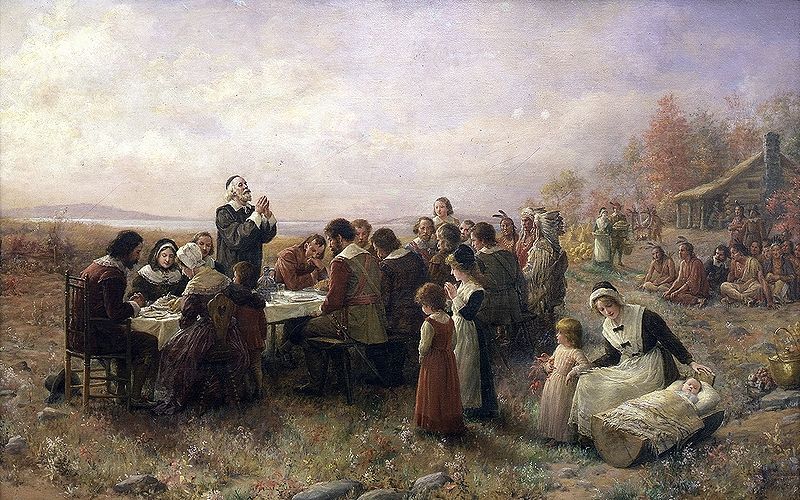
Revisiting The Myth of Yams and Pumpkin Pie

"The First Thanksgiving at Plymouth" (1914)
By Jennie A. Brownscombe

With the approach of Thanksgiving, elementary school aged children in the United States prepare to play yams in school plays, and sing songs about pumpkin pie and cranberries. They may dress up as Pilgrims in costumes with black hats and large, shiny buckles. And they often mime a feast with Native Americans signifying the beginning of a tradition of giving thanks in November. Their parents are undoubtedly delighted—as they should be: every child needs a picture dressed as a yam. 

These elements of Thanksgiving are the same half-truths that I was taught as a child. I say half-truths because Thanksgiving is a constructed holiday—over the years we have pieced together history and popular customs to create this national festival. It's based on a feast of thanksgiving, a religious event where the celebrants gave thanks to their god(s).

Wednesday, November 17, 2010

Monday, November 15, 2010

Evolving Together: Human Interference Not ALL Bad


There is no denying that humans have had a lasting impact on the environment, however biologist Jacques Blondel (2006) suggests that these ideas overlook the ways human activity has actually contributed to the maintenance, diversity, and embellishment of landscapes (714). Blondel acknowledges that there is a middle ground between these ideas when it comes to the relationship we have with our landscapes—a balance must exist between resistance and resilience, between disturbance and recovery. While Blondel focuses his discussion largely on the Mediterranean, perhaps these ideas can also be applied to our own local landscapes, and help us understand how biodiversity can evolve in these circumstances.